Flaming Athena: The Light of Revelation
A contemporary embodiment of the goddess through the philosophy of Parmenides
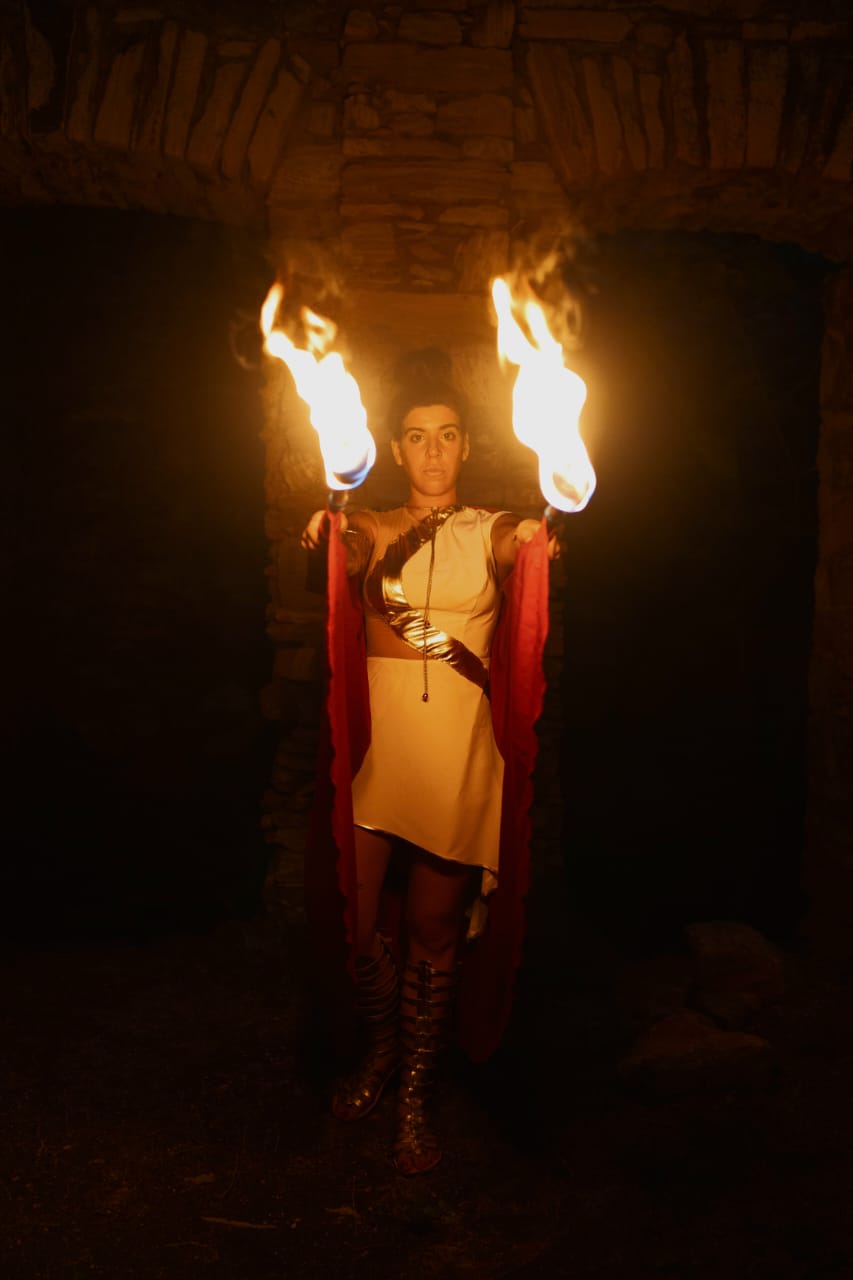
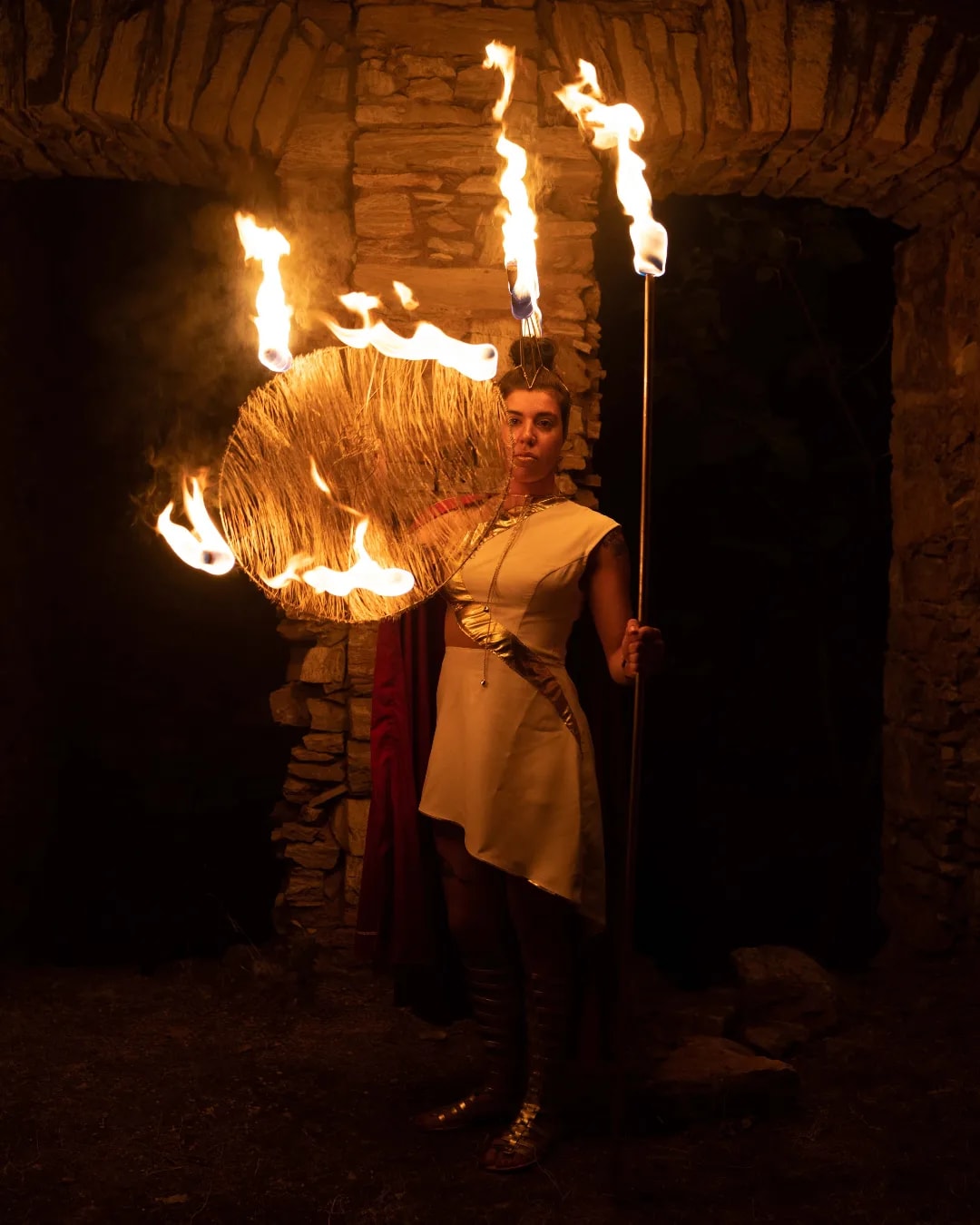
The work «Flaming Athena: The Light of Revelation» is a contemporary video performance and visual installation that seeks to establish a dialogue between Pre-Socratic philosophy, ancient Greek mythology, archaeological iconography and contemporary performance art. At the center of the work is a three-dimensional representation of the goddess Athena, combining elements of ancient divine and martial iconography with the expressive means of contemporary performance. Through fire, metal, body, music and moving image, the figure of the goddess is transferred from her historical and mythological context into a contemporary urban space.
A central axis of the work is the concept of spiritual awakening and the symbolic journey of human beings from darkness towards light. This is a journey that, although already articulated within ancient philosophical world, remains largely uncharted for contemporary humanity. In an era characterized by speed, information overload and the constant production of images, the work raises the question of whether the pursuit of knowledge and truth continues to constitute a fundamental human need.
The philosophical point of departure for the installation is Parmenides’ poem «Peri Physeos». In the prologue of the poem, the poet describes a symbolic journey towards a place of revelation, where a divine figure reveals to him knowledge concerning truth and Being. This journey constitutes an important philosophical foundation for work, as light and revelation are symbolically associated with the transition from illusion and opinion (doxa) towards knowledge of truth.
The connection between the divine figure of the Parmenidean prologue and Athena constitutes a deliberate artistic and interpretative choice and the outcome of research. In the surviving poem of Parmenides, the goddess is not explicitly identified as Athena. Nevertheless, the present artistic approach establishes a parallel between the goddess who reveals the truth to the poet and Athena, who, within the Greek cultural tradition, is associated with wisdom, knowledge, strategy and intellectual power. Athena, thus, becomes a contemporary embodiment of the divine principle that guides the human being towards knowledge, without this artistic identification being presented as a historical conclusion regarding Parmenides’ work.
The choice of Athena acquires further significance through the contemporary research of Italian researcher Marco Montagnino, who proposes a connection between the unnamed goddess of the Parmenidean prologue and the Athena worshipped in the Phocaean colony of Elea. This approach connects Athena with a broader network of cultural contacts between the Phocaeans and the Eastern Mediterranean and Egypt, particularly with Naucratis and Sais, where the Egyptian deity Neith was associated by the Greeks with Athena. (Montagnino 2025)
Fire constitutes the primary material and symbolic medium of the work. It does not function primarily as an element of destruction, but rather as light and revelation. It makes visible what was previously concealed in darkness and transforms the body of the goddess into a living point of light. In this sense, fire symbolizes the process of spiritual awakening and the pursuit of a deeper understanding of human existence.
Athena is also approached as a “Woman of the Mediterranean”, a timeless figure of wisdom and strength. She does not belong exclusively to antiquity, but functions as a cultural archetype that transcends periods and geographical boundaries. Through the work, the divine figure relates to the contemporary female body, strength, determination, and wisdom, creating a bridge between the woman of antiquity and the contemporary woman.
Visual Research and Archaeological References
The design of Athena’s figure and armor was based on the study of ancient iconographic models. A particularly important reference in this process was the study of an Etruscan terracotta antefix featuring the head of Medusa, dated to the 6th century BCE and recorded in the collection of the Metropolitan Museum of Art as Terracotta antefix with the head of Medusa (acc. no. 27.122.14). The Gorgoneion displays characteristic features of the Archaic representation of Medusa, including large eyes, a widely open mouth, an extended tongue, exposed teeth and a dramatically distorted expression. These features served as a primary morphological reference for the design of the Medusa on the shield of the contemporary Athena. At its center, the shield incorporates the Gorgoneion, surrounded by a spiral form positioned behind the head of Medusa, functioning as a symbolic reference to the sun and to the light of revelation.
The archaeological reference was not reproduced literally. The two-dimensional model was transformed through a process of contemporary artistic translation into three-dimensional metal constructions, specifically designed and fabricated for the installation. This process transforms the ancient image into a contemporary object and, subsequently, into an active element of a video performance. In this way, archaeological memory is not treated as a static historical remnant, but as material that can be reinterpreted through contemporary artistic practice.
Another significant iconographic reference was the statue of Athena wearing the aegis and bearing the Gorgoneion, preserved at the Acropolis Museum. Of particular importance is Athena Acropolis 142, dating to around 500 BCE. In this representation, the aegis covers the upper part of the body and bears a large Gorgoneion at its center. Along its edge were holes intended for the attachment of marble snakes, while two additional snakes were associated with the head of the Gorgon itself. The goddess held a spear and a shield.
The video performance further expands the relationship between the ancient object and the contemporary work. The fire, the body, the music and the moving image create a temporal and sensory experience. The epic musical score functions as a dramaturgical element, highlighting the vitality of Being and the agonizing, incessant effort of the soul to free itself from its inner bonds. The transition from stillness to movement and from darkness to light becomes a symbolic process of awakening.
In conclusion, the work proposes a contemporary interpretation of the concept of revelation. Light is presented not merely as something that illuminates the external world, but as an internal process of transformation. Flaming Athena becomes a symbol of an ongoing journey: from image towards essence, from darkness towards light, from ignorance towards knowledge, and from myth towards a new, contemporary experience of Being.
For the realization of the artistic composition and the construction of the figure of the goddess Athena, technical and creative support was provided by fashion designer Marieta Pantazi, who contributed to the design and sewing of the goddess’s garment, and by blacksmith George Touloumis, who provided technical support for the metal welding and fabrication of the installation. The audiovisual and photographic documentation of the work was carried out with the contribution of Theodoros Margaritis and Meletios Vaxevanidis, who undertook the photographic and video recording of Flaming Athena.